Americanism Redux: Your Today, November 26, On The Journey to the American Founding, 250 Years Ago, In 1776

You’re in a boat and you’re taking on water. No denying it. The only question is how many holes there are. If it’s one, a patch could work. If it’s ten, abandonment is probably the only option.
Defeat is a lot like that leaky boat. One defeat is manageable. You can handle it. But ten, and all at what feels like once? That’s not defeat anymore. That’s futility, with just one thing left to say:
Abandon ship.
You’re in Americanism Redux, 250 years ago today, with the boat filling up and the future feeling sopping wet.
* * * * * * *
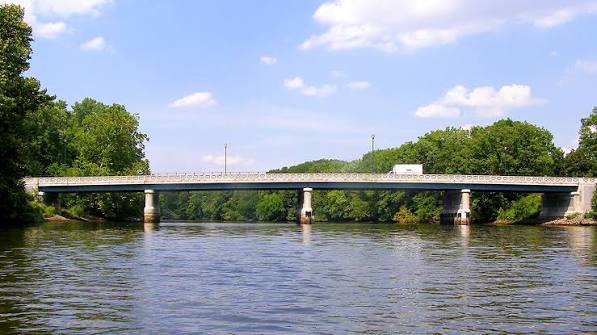
(a bridge still up on the Passaic)
Okay, we’re done. Back in formation. Feet soaking wet from the frigid water and cold mud. Clothes that were already threadbare and stinking are more so now. Several men are barefoot. Get your gun and get your gear, and hopefully in a couple of hours we’ll be able to crouch down by a campfire. But don’t expect much; it’ll be smoke more than flame, drips of hissing moisture from the ends of wood that boils rather than burns, and lots of coughing and rubbed eyes from the heavy, acrid smell. Probably about right for the shape we’re in—a wet campfire makes you feel low, especially when you leave this miserable version of a heat source and then have to fall asleep without a tent.
The lousy campfires and nonexistent tents are payoff for hours of very hard labor by squads of Washington’s men. At his order, they tore up the Adquackanonk Bridge over the Passaic River at Passaic, New Jersey, near Newark. The structure is, or was, 200 or so feet long, 12 feet wide, plank wood and hewn logs with stone-filled cribs as pillared supports. They used axes, saws, and crowbars. They destroyed the passage to the bridge as well, cutting down trees, cutting up the road, cutting off approaches to the imposing span.
Washington hopes the dismantlement of this bridge—a vital spot for local residents’ transportation—will slow down the enemy Redcoats who are chasing down his “moving Army.” All that’s left standing in the gray air and dark water are jagged remnants of upright pile supports, the Passaic ghosts.
Some local people aid the destruction with their labor and tools (the soldiers had none), a sign of their human support for the army and the Union. Other local people tally the total differently; small groups of enslaved people—like Hagar Bruen, 37 years old, and Kassey and Eli Aitken, 12 and 7 years old respectively—spot the Redcoats, mark them as their best and quickest chance at freedom, and slip from their farmer-enslaver Joseph Alling—into the flow of British professional soldiers marching south toward the ghosts.
* * * * * * *
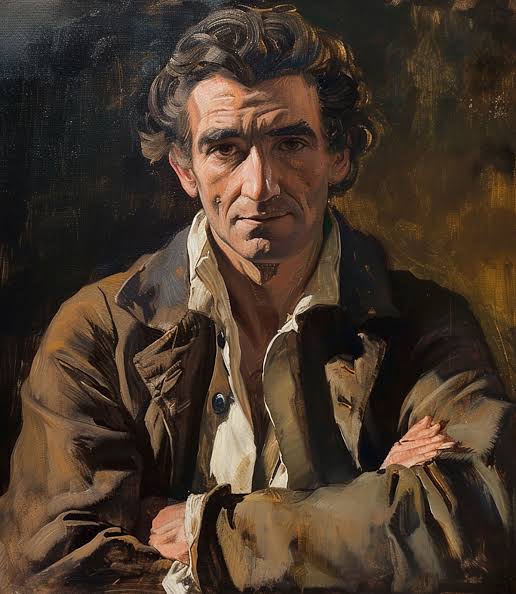
(Paine)
Thomas Paine, a member of Washington’s force, senses the waning spirit of the soldiers around him. Paine, whose army experience coincides with the “Flying Camp”, precursor to Washington’s first use of the term “moving Army”, decides these men need a voice. He wants to explain who and what they’ve become to people who might have the wrong idea of their conduct and capabilities. He seeks to repair the public mood around them, to restore the bond between the people who fight and the people for whom they do the fighting.
To write his work, Paine assembles the facts of the soldiers’ reality as he sees it daily. They operate in spaces where only short distances separate them from their enemy. In these spaces, supreme importance attaches to the smallest features, such as a bridge or a road. The prospect of battle hasn’t vanished; in actuality, the opposite is true—battle can appear suddenly, including against a larger opposing force. A constant, though, is to be on the move to avoid defeat, to pack up and go with scant notice, which also means that things can get left behind. They’re in no one place for long, always look out for entrapments, and rely on local people to supplement their strength.
Paine’s goal is to harness the reality of this army to the panic of the people at large. The needs of the one can be met through the energy of the other, but only if they can be connected in mutual understanding.
* * * * * * *

(Washington)
Washington’s force is down to just a few over 3,000 men. A December 1 deadline is also coming for hundreds of volunteers whose term will expire on that date. In a real sense, December 1st is every bit as effective an enemy as the British—it will cost Washington a substantial part of his force but without any shots fired in combat. The future holds a volunteer deadline as a certainty and a battle as a probability. Combine them and you get one picture: the bottom is out of the tub.
None of this was what Washington had in his head when he first coined the phrase “a moving Army” a few weeks ago.
Both in stitching the notion and the words that expressed it, Washington had envisioned a mobile force, superior to the enemy in speed of movement and deliverer of lethal strikes at the place and moment of contact. He also saw it hazily as an extension of the people, the Congress, and the Union. The notion further hinted at the land in human form, vast, flowing, defiant of invaders from an older world, a strange identification and confluence with the Natives he and others had tried to push aside. An idea not natural or preferable to him, it was the product of these last several weeks, seemingly the best and right way to stay afloat.
Life for Washington, however, is more than a set of revealed ideas. He’s in the midst of rising water, ankle-deep but pouring in by the hour, as soaked to the bone as the men destroying the Adquackanonk Bridge, the actions of which he personally supervises and oversees.
Washington writes to General Charles Lee, whom he is desperate to add, with his own force, to the dwindling main army: “this Country [the landscape of New Jersey] therefore will expect the Continental Army to give what Support they can & failing in this will cease to depend upon or support a Force from which no Protection is given to them. It is therefore of the utmost Importance that at least an Appearance of Force should be made to keep this Province in the Connection with the others—if that should not continue it is much to be feared that its Influence on Pennsylvania would be very considerable & more & more endanger our public Interests.”
Washington knows he can only urge the Continental Congress to prepare Philadelphia for an onslaught by the enemy. He provides no substantive help in that process because he has no material support to offer. He knows as well that he can’t even rely on effective deliveries of messages, reports, and updates through a mail service deeply affected by enemy subversion and monitoring. The ability to fight, to protect the homes and towns of the Union’s supporters, to even communicate messages back and forth to the Union’s constituted governing bodies, is sinking.
* * * * * * *
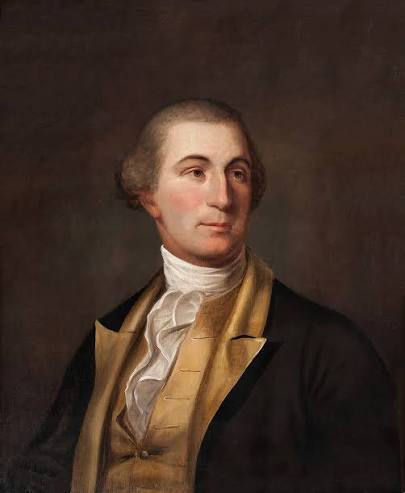
(Reed)
Washington’s changing attitudes are not met with acclaim. His personal secretary, Joseph Reed, opens a deeply critical correspondence with Charles Lee at the same time that Washington is writing to Lee. Privately, Reed states to Lee that Washington lacks decisiveness, leaving room for less-capable officers like Nathanael Greene to exert influence. Reed praises Lee for his independent thought and grasp of military strategy and tactics. Reed also encourages Lee to approach the Continental Congress with a veiled offer to gain more authority and command of the war effort. Unknown to Reed, Lee had already softly started such a campaign of persuasion.
If the army is a vessel, water is pouring in through various leaks. The inner circle is cracking.
* * * * * * *
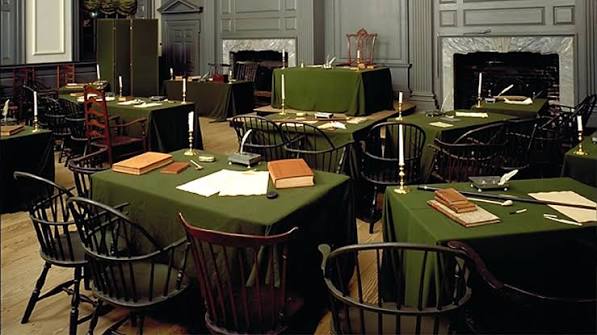
(scene of fast action)
The looming disaster produces a reaction inside the Continental Congress. Leaning on a technique that had been used since its earliest meetings twenty-five months ago, the body convenes and designates five members to form a special committee “to devise and execute measures for effectually reinforcing General Washington, and obstructing the progress of General Howe’s army; and they are ordered to proceed immediately on this business.” Three delegates from Pennsylvania join the quintet—James Wilson, James Smith, and George Clymer—while Samuel Chase of Maryland and Richard Stockton of New Jersey round out the group. Within a day, they decide on ten key actions, ranging from personnel to equipment, from pay to authority, from loyalty oaths to currency distribution. This five-delegate committee embodies the Continental Congress’s commitment to maintaining civilian control over the military. Back in the summer, a five-delegate committee had drafted a declaration of independence. Now, in the late fall, another five-delegate committee steps forward to draft an execution of war.
If the boat sinks, the abandonment of a founding principle won’t be the reason.
* * * * * * *
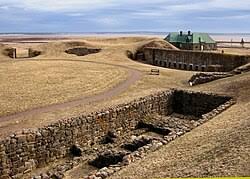
(Fort Cumberland)
Jonathan Eddy sits on the night of November 26, close enough to see the outlines of Fort Cumberland on the horizon of Nova Scotia. He’s there with fewer than two hundred men remaining after a long siege and then desperate attacks on the fort held by the Loyalist forces known as the Royal Fencible Americans. Eddy’s group has a ragtag assortment of Massachusetts men along with allied Native Mi’kmaq and Passamaquoddy warriors. Nothing seems to work against the Loyalists. The arrival of a British warship threatens to terminate all the hopes of Eddy and the besiegers for victory. Meanwhile, on an opposite coast of Nova Scotia, John Paul Jones commands an American vessel on a separate mission, capturing a British ship carrying 10,000 winter uniforms. That’s a desperately needed prize for the “moving Army” of Washington.
Eddy’s failed assaults of two days ago are the most recent part of a year-long attempt to make Nova Scotia a part of the American Union and Nation. An effort that had shown early promise dissipated into a sequence of setbacks. These latest scenes of a Union force attempting to slog it out against a fort on fixed lines require resources that the attackers don’t possess.
The question is whether the Nova Scotia theater is a micro example of a macro trend—where the smaller location portends the larger direction.
* * * * * * *
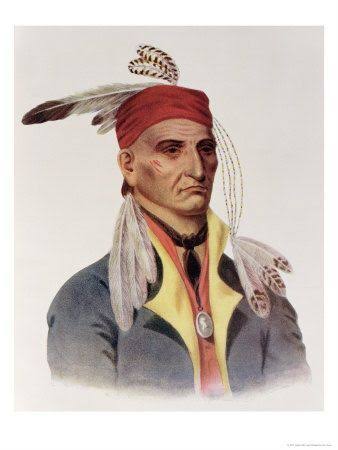
(Attakullakulla)
Attakullakulla is an elderly leader among the Cherokee villages in the eastern Appalachian Mountains. A former captive of Natives in eastern Canada, he knows what life is like in a world apart. He looks around him today, 250 years ago, in the immediate days following the latest attacks by the Virginia-North Carolina-South Carolina collaborative war against the mountain-based Cherokee. He sees famine, homelessness, disease, and death. To him, the best path ahead is the only path reasonably available—to make a negotiated peace succeed with the American Union and Nation.
His adversaries, aside from the three-state militia force that killed or uprooted many of his people, are three: one is his son, Dragging Canoe, who wants a wider and seemingly endless war, and the second is a long-time friend, the British agent John Stuart, whom the Americans want dead or captured. His son wants war to continue, while his friend wants to finance and support such a war. The remaining adversary is so numerous as to be faceless and impersonal—political leaders from the three states are vying for control of Cherokee leaders like Attakullakulla, the people who follow him, and perhaps most of all, the lands they still occupy.
The 76-year-old Native leader may never have faced such a bleak set of choices.
* * * * * * *
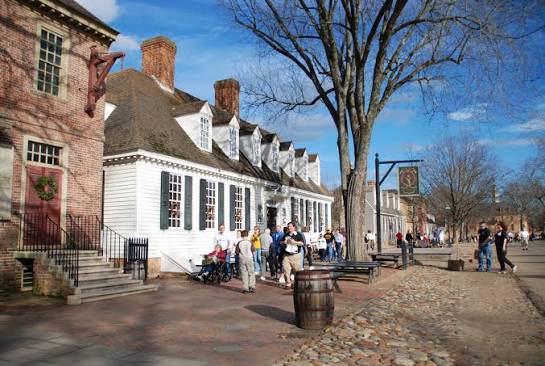
(part of Dixon’s marketplace)
John Dixon’s newspaper, the Virginia Gazette, wages a fierce competition to stay afloat in the media market of Williamsburg, Virginia. In keeping with the times and demonstrating his allegiances, he has changed the masthead to include a quotation from the new Virginia constitution. He’s also decided to charge an extra fee for “controversial” articles inserted by writers in his newspaper. And he’s demanding payment of every penny of money owed to him. It’s his campaign to stop the sinking.
He’s making another decision as well. Dixon prints in his newspaper’s latest edition “An American Song, to the tune of ‘The Watery God’ “. Dixon is hoping for a twofold win—inspire a darkening public mood, and capture the attention of a paying readership seeking inspiration in a darkening public mood.
The lyrics, printed by Dixon, are an unusual choice. They refer to George III and to Lexington, both examples of the war’s earliest days in spring 1775. They make zero mention of independence, of George Washington, of the Continental Congress or the Continental Army, of anything specific to 1776. Their far shore seems to be charted in the separation expressed by Paine’s Common Sense. But perhaps a second thought is in order: with growing fears about a diminishing American war, the basic cause and the first source might be exactly the right focus.
It’s circling back to the forgotten days to buy a hopeful newspaper with a few extra coins.
* * * * * * *
The water streaming into the boat feels like it’s coming from many directions.
Also
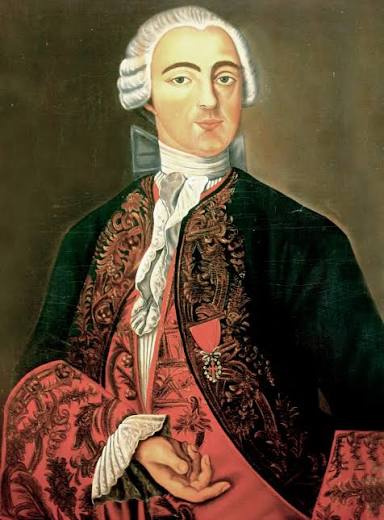
(de Cevallos)
Pedro Antonio de Cevallos walks the deck of his flagship, El Poderoso. He’s the leader in the leading vessel of this 120-ship flotilla carrying more than 9,000 soldiers. The entire group is an ocean-going representation of Spain, plowing the waters of the South Atlantic Ocean with a single objective in mind: capture Portugal’s Santa Catarina in South America and then drive inland. Doing so will cement Spanish control of the southern continent at the expense of Portuguese rivals.
It’s an opportune moment with British attention aimed at the American war. Despite a long heritage of diplomatic and military allegiances between England and Portugal, British imperial officials are not expected to devote resources to assisting Portugal. British indifference will anger the Portuguese government, which had acted in opposition to American independence as a gesture of friendship toward England. These are moves on the global chessboard.
On board with Cevallos is a large shipment of saddles. They’re an ironic cargo in light of the Spanish introduction of horses to the New World back in the sixteenth century. Horses are now so prevalent in South America that Cevallos will have no trouble getting mounts for the military operation.
Secure, well-outfitted, and dry as dust, the Spanish flotilla heads east of the Canary Islands toward Cape Verde. It’s all open waters after that.
For You Now
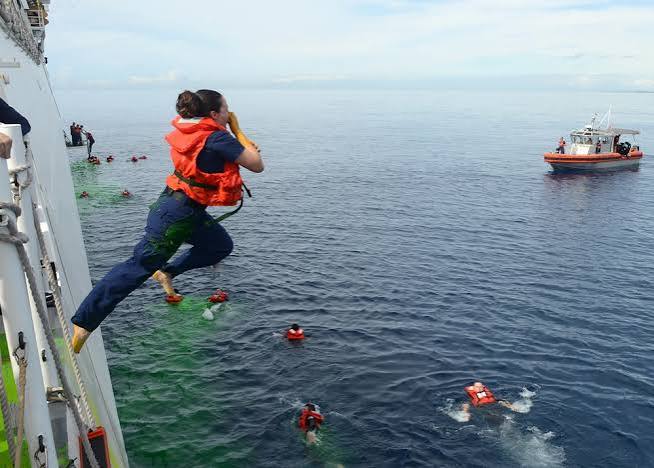
People have yelled “abandon ship” for a lot less cause than we’re seeing in this entry of Americanism Redux. Everywhere you look the water streams into our vessel; several holes must exist and the patching material seems limited.
Urgent and panicked though it is, the general tone is for repair, not abandonment. Some (Washington) are seeking a change in how armed power is used. Some (Paine, Dixon) are seeking to re-engage and recommit people to armed power and the cause it serves. Some (Reed, Lee) are seeking a change in leadership of the armed power. Some (Continental Congress’s five-delegate committee) are redoubling their efforts to provide meaningful control of the armed power.
A range of choices can be seen in the western war with Natives. The clearest point among them is that the greatest challenges exist in the choice of peace and the end of war-making. Everything stacks against peace.
Two other points, both historical and leadership in orientation. First, do you remember those borrowed tools at the bridge? Local people provide them. If they don’t appear, the bridge stays intact and the Continental Army is smashed to pieces. Local support makes all the difference. A lesson here, it feels to me, is that the resources for patching the leaks can have an unusual look. Come to think of it, those fleeing enslaved people following the British Army embody a unique definition of support and cause. British decision-makers don’t fully understand that.
Second, Washington changes his warmaking outlook. If he stays rigid, if he clings to what he knows, he and the cause for which he’s fighting are done, finished. Each day he’s adding a realization, an adjustment, a discovery, to his “moving Army” concept. Almost every hour is painful or disappointing. The resilience for which he’s now well known is an iron pot; within it, his weeks boil and bubble with a scalding heat.
Out of the heat comes the tar, thick and steaming, ready to use in sealing the cracks, covering the holes, and stopping the leaks.
Suggestion
Take a moment to consider: are you a confident patch-maker?


Speak Your Mind
You must be logged in to post a comment.