Americanism Redux
August 20, Your Today, 250 years ago, in 1776

“Time’s up. Gotta make a decision.”
You’ve heard or said that phrase or something close to it. Many times, in all likelihood.
About a thousand things go into that moment.
Welcome to Americanism Redux, 250 years ago today.

* * * * * * *
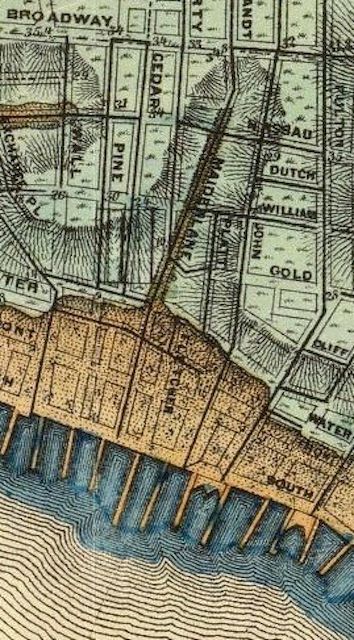
(Maiden Lane is the linear extension in the middle)
Mary Ferrara knows it’s time—time to make a decision that could affect the rest of her life, and certainly the rest of this year. She’s reading the “General Order” that’s been issued from the headquarters of Continental Army Commanding General George Washington.
All women, children, elderly, and infirm should evacuate the city of New York immediately. A massive invasion by the British Redcoats will begin at any hour. Leave now to protect yourselves. To the protection of property and possessions left behind, Washington pledges the honor, duty, and service of the Continental Army, itself a creation and extension of the Continental Congress, which is itself the highest organizational embodiment of the Union’s newly declared independence.
But people like Mary Ferrera must get out now.
Mary has seen it coming, of course. Symbolic of the unfolding disruption, the town’s post office has relocated to Mary’s house and inn on Maiden Lane, halfway between Fly-Market and the Broad Way. Known to everyone in her neighborhood, it’s decision-time for Mary Ferrara.
Meanwhile, in another General Order from Washington’s headquarters, Continental Army Private John McElnay and every other member of this Union’s armed force in New York City receive instructions to cook three days of meals and have their canteens filled with water. An alarm could come at any moment and it’ll be “time’s up and a decision’s gotta be made” to get to your posts to await the enemy.
* * * * * * *
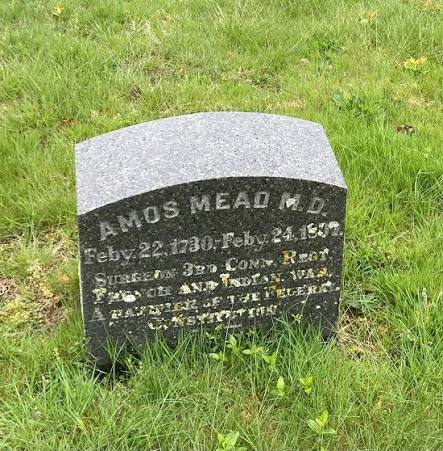
Near New York City is Dr. Amos Mead of Greenwich, Connecticut. He and a handful of other people have taken on the task of organizing Greenwich’s defense in this explosive situation. The problem is that almost all of the men between 16 and 60 years of age have been called to New York City to shore up George Washington’s Continental Army. Same with the weapons and ammunition in the village—gone to NYC. Mead is asking Washington and the Continental Army for an exemption from providing any more men or material to New York. For Mead and his Greenwich village, time is up and a decision has to be made to attend to the village above all else. The same is true for a dozen other Meads in a dozen other villages under crushing pressure trying to bolster Washington’s force in New York City.
* * * * * * *
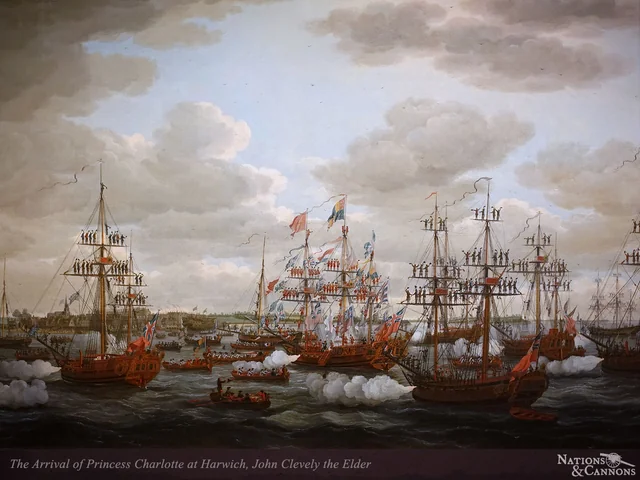
(96 of them)
Somewhere among the 96 British vessels in and around New York harbor—that massive enemy ready to lunge at Washington’s Continental Army—you’ll find William Howe, commanding General of the British forces. From the deck of his ship, Howe has been exchanging letters with Benjamin Franklin in Philadelphia. Howe laments the misconception that he was bringing from London the authority to negotiate imperial-colonial differences. He further believes that restoring the rebellious colonies to the empire’s “permanent union” is the best goal for the future.
At the same time, an unnamed Loyalist is on board one of the 96 British ships. In a letter the Loyalist writes sneeringly of the “Puritans” in New England and their “high holiday season (that) they enjoy with rapture all over the country.” The Loyalist compares them to “the king-killing tribe during the English grand rebellion”, the mid-17th century’s English Civil War and the uprising led by the Puritan Oliver Cromwell.
Both Howe and the Loyalist see the rebellious Americans in New York City as this century’s example of malcontents seeking to overthrow the British government. The time has come and the decision is final: the coming battle is the consequence of their actions.
* * * * * * *
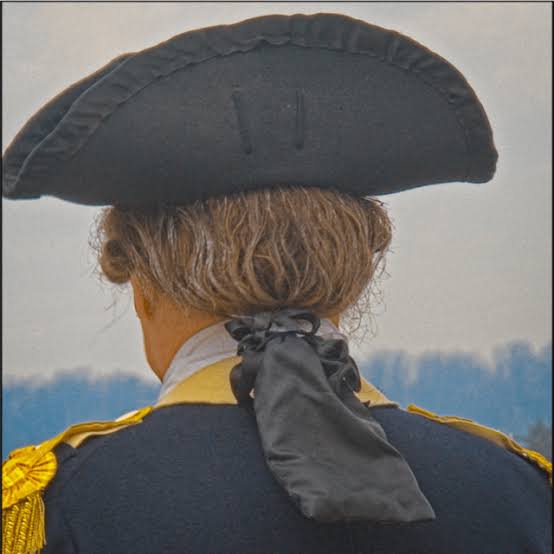
In New York City, newly-promoted General Samuel Holden Parsons, like Dr. Mead a resident of Connecticut, is certain that competent officers are part of the key to the Continental defense of the city. He’s seen more than his share of the opposite—the wrong men getting promoted because of political connections and political favors. He’s convinced that he has to act to prevent more of the same. Parson believes John Adams, chairman of the Board of War created by the Continental Congress to oversee the Union’s military policies, must be informed of the best-, and worst-, qualified candidates for promotion.
Also in New York City, Colonel James Varnum of Rhode Island knows about the current military gap between competence and promotion. From his vantage point, he’s been overlooked for advancement more times than he can count. And now, for him, it’s almost the “time’s up/gotta-decide” moment—he’s fed up and even in this time of crisis, he’s packing his bag to leave Continental Army. His last act is to agree with General George Washington’s request to meet and discuss his decision.
From the Continental Congress in Philadelphia, Board of War chairman John Adams fills a long letter to Parsons with complaints, commiserations, and pontifications about the ineptness of American military power thus far. Adams adds that maybe he’ll mimic Oliver Cromwell and become an officer late in life while, as an afterthought in a postscript, he informs Parsons of a few promotions.
From his Continental Army headquarters in New York City, General George Washington pleads with Varnum to reconsider his resignation. He succeeds in convincing the young officer to stick with the cause by staying at his post, in the field, waiting for the enemy.
Two officers, two routes, two communications with higher-ups in the Union’s young system of armed power. The time is now and the decision’s done.
* * * * * * *
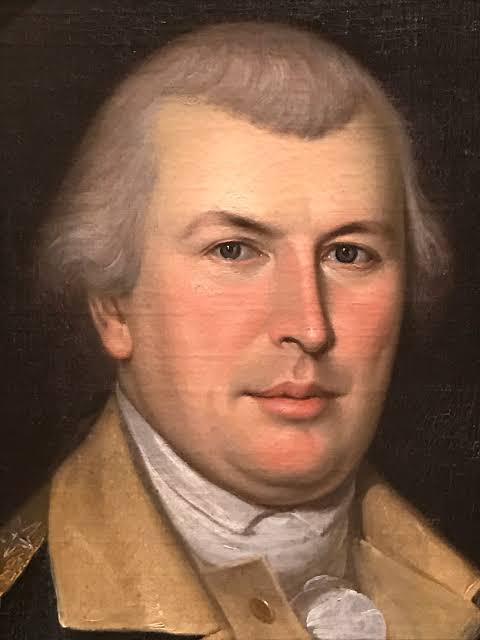
(with a raging fever)
The time is up for General Nathaniel Greene’s health and the decision is—get to bed and stay there until his raging fever subsides. A Rhode Islander like Varnum, Nathaniel Greene has quickly emerged as one of Washington’s most talented generals and members of his core team. One expression of that talent is Greene’s instinctive understanding of things that others fail to consider; for example, Greene notices that soldiers are more effective when they stay together as a unit and if the unit can be in the place for a period of time. Excellent.
But that’s gone for now. Greene has taken an unofficial absence for his illness. Washington now is forced to decide to substitute another general for him until he’s better—he picks John Sullivan, who is loyal, unwavering, and straightforward. He’s also lacking in the creative thinking and fresh insights that seem so natural to Greene. Sullivan will be in charge of an important part of Continental defenses if the likely British attack comes.
* * * * * * *
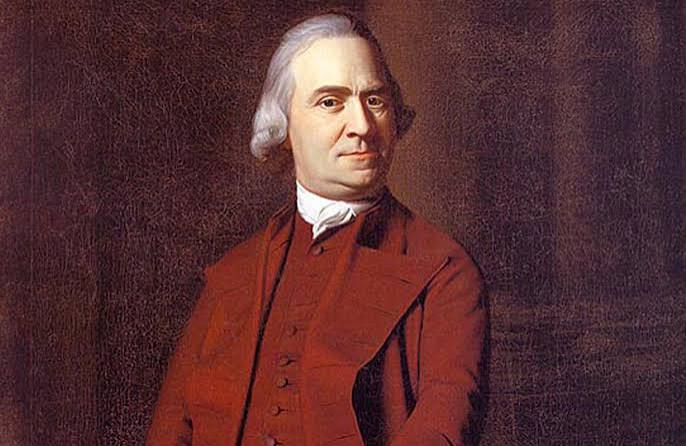
(Samuel Adams)
Samuel Adams, Continental Congress delegate from Massachusetts and John’s cousin, leaves New York City to return to Philadelphia. He’s been inspecting Continental defenses. His visit leaves him with these convictions about Continental soldiers: pay them more, offer land along with wages, and increase the service term to three years. He sees the policies as crucial to improving the army when the impending clash in New York City is over and done.
* * * * * * *
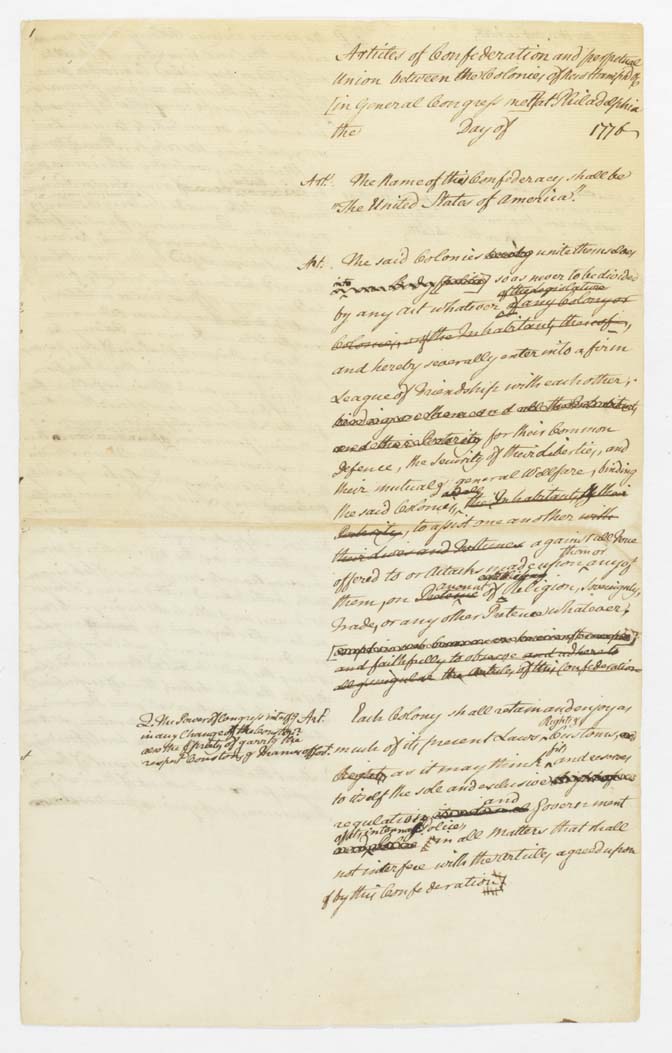
The Continental Congress to which Samuel Adams will return is saturated with decisions that have reached their time. It’s been an exhausting struggle.
As of today, 250 years ago, the Continental Congress finalizes the second draft of the Articles of Confederation, making this one of the most important weeks of the summer. Among the changes from draft one to draft two: no national taxes, no centralized interference with states’ internal police policies, no salaries from a second governmental office to delegates, the allowance of term limits, one vote per state, a supermajority of nine states from the thirteen to pass legislation, and a watered-down executive. Still to be decided, and each of which produces bitter divisions, is, first, state ownership, or not, of claimed territory in the west and, second, how to apportion taxes among states.
There’s also intense disagreement over how the states view and approve the Articles’ second draft. Some are arguing for a special convention to vote on it. Others want the people in each state to directly vote on it. Still others urge the states’ legislatures—if they have them—or some other entity should be organized to vote on them. Criticisms are loud about the utter removal of any acknowledgement of debates, votes, amendments, changes, and edits of the second draft by specific delegates or state delegations in the Continental Congress.
But the war demands attention here, too. Amid the second draft controversies, Edward Rutledge of South Carolina declares that the Continental Congress has to find the time to consider how to improve the conduct of soldiers and the effectiveness of the Army. He admits he can’t yet understand how to remove undesirable soldiers as battle looms.
It’s as if two vast streams of events, one in war and one in governance, rush alongside each other. The peace governance needs is the condition war denies. Battered, bruised, and frustrated, delegates stumble out of their sessions as the summer heat burns on.
* * * * * * *

(in August)
Simultaneously, beneath the Sirius Dog Star and among the serious dog days, several conventions are also occurring WITHIN states as delegates in a half-dozen sites wrestle with state constitutions. Massachusetts, New Jersey, Pennsylvania, and Maryland are among them. In the latter, for instance, elections are confused and contested with 42 out of 76 delegates showing up and voting to endorse independence; delegate-candidate Thomas Johnson refuses to accept defeat in Anne Arundel County and is now looking for another county in which to seek election to the state convention. On a more macro-level, John Adams criticizes states that want to include a single-house legislature.
It’s creation upon creation, design upon design, draft upon draft, with chords stretched taut between change and continuity and looped, twisted, and knotted among themselves. People are looking at building mechanisms for government inside their own town, county, and state, with quizzical glances at neighboring states, and suspicious gazes at the Continental Congress. All of the visions have to fit inside the Union.
* * * * * * *
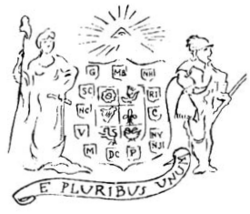
(the Swiss offering)
Three of the members of the Continental Congress’s original writing committee for the Declaration of Independence are back at it. John Adams, Benjamin Franklin, and Thomas Jefferson have taken up a new committee assignment—to design a national seal. They’ve engaged a consultant, Pierre Eugene Du Simitiere, a Swiss immigrant, who at one time had been a lodger at Mary Ferrara’s inn on Maiden Lane in New York city.
All four offer designs. Franklin wants to emphasize Moses and the Book of Exodus. Jefferson likes the Exodus idea but wants to balance the religious with imagery from the Saxon period of ancient English history. Adams prefers Roman mythology and Hercules. The Swiss consultant encourages the use of shields to illustrate the states and the European areas of immigrants combined, amazingly, with an irregular soldier who is a frontiersman, clad in a hunting shirt and carrying a rifle and tomahawk—unknown to the committee and consultant is that at this very time Philip Livingston is informing one of those state constitution conventions, the New York Provincial Congress, that irregular “rangers” will help western families feel safer in the current war, much as they’re doing in South Carolina.
Crunched for time and fully aware that these four views point the Union in different directions, the Continental Congress’s delegates delay on a final choice. Inaction is the decision.
* * * * * * *
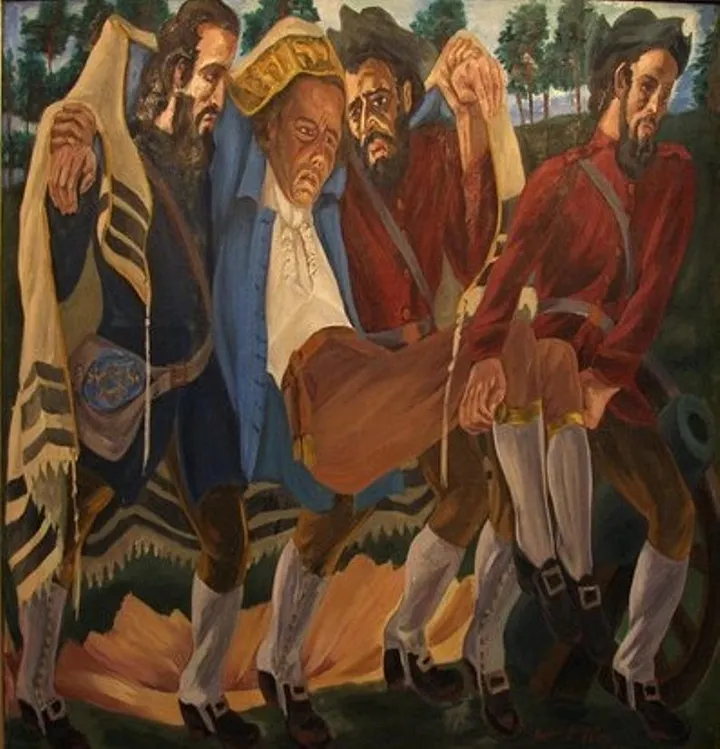
(a depiction of the first Jewish death of the American Revolution)
The war bends life in unexpected ways. While the smallpox epidemic is perhaps winding down, people puzzle over why inoculation has proven so ineffective in this instance—is it that war has brought people together who would otherwise have not come into contact with each other? In addition, reports from Abigail Adams outside Boston assert that children in her town seem out of control, acting in open defiance of parents and teachers. Samuel Cooper states that a trend in New York City is money issued in a war-affected area may have more credibility in the marketplace than in non-war regions; he says only a single Continental-wide currency may change that. Christopher Ludwick, a German immigrant and renowned baker, has offered to serve without pay to produce bread for the Flying Camp in New Jersey and covertly recruit German soldiers with the British to desert and relocate to a Union community. A plan in New Jersey has been sketched for an all-black regiment of Continental soldiers—Samuel Sutphen, Cuff, and the intriguingly named Oliver Cromwell are three black men among hundreds of others in New Jersey who could seek to enlist in such a unit. The plan doesn’t have approval as of yet; John Adams suggests that South Carolina would immediately bury it.
And of the burials from this war—in Charleston, South Carolina, Marks Lazarus and other Jewish residents are stunned to learn that Francis Salvador, one of their most prominent attendees at synagogue, was killed and scalped by Cherokee Natives two weeks ago a hundred miles inland. It’s part of the irregular war that’s been destroying Native and white settlements. With the body missing, Jewish leaders like Lazarus are in the midst of discussions on how to proceed with Judaism’s burial rituals. It’s a complex question worsened by shock and grief.
* * * * * * *
The end nears for the last full month of summer, and decisions must be made on gathering the bounty of fall.
Also
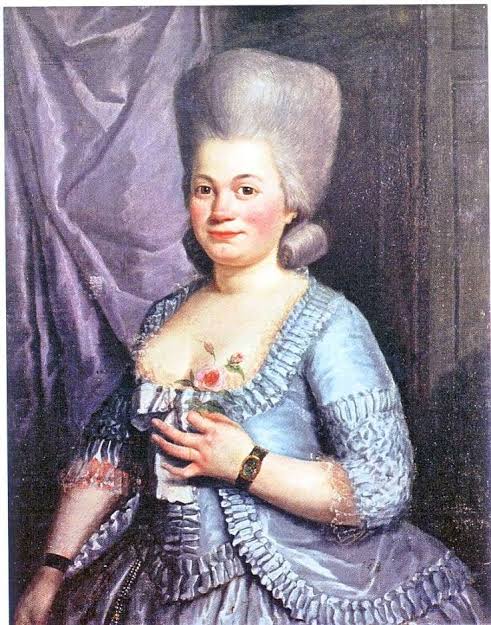
250 years ago, French King Louis XVI creates a half-dozen merchant guilds and forty-four corporate entities in the arts and trades. His action is an effort to stabilize a tumultuous economy roiled by reforms pursued by his one-time minister of finance, Jacques Turgot. A whiff of deep social unrest was unleashed by Turgot’s attempted changes to reduce economic restrictions.
Ironically, part of the monarch’s moderation is extreme. He declares that women are to be openly acknowledged and encouraged as members or leaders. Prominent among them is 29-year old Rose Bertin, a close friend of Marie Antoinette’s, who is eight years younger than Bertin.
Bertin is highly skilled as a designer and maker of fashionable clothing, headdresses, and assorted trimmings for women’s apparel. She knows the time is right for a new opportunity to be seized if she can secure the leadership of the fashion guild.
* * * * * *
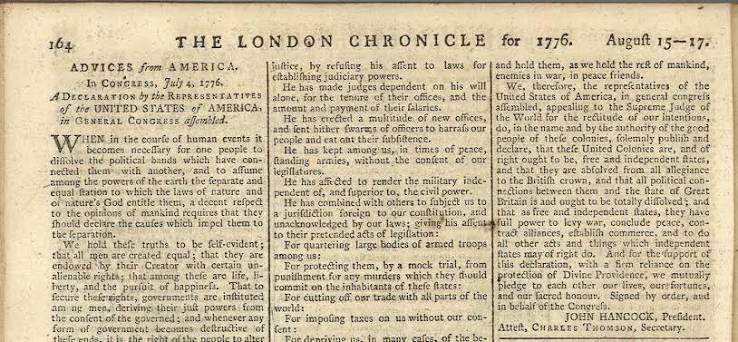
The chance to read a printed copy of the Declaration of Independence is spreading across London and other English communities. Local newspapers are including the document in their new editions this week. What was once reported is now readable. As for the status of the 32,000-man armed force sent to America by King George III, it will be somewhere between eight and twelve weeks before ships sail back from the New World with any meaningful news.
Fall will have begun by then.
For You Now

We’ve found a new acronym: TUGD. Times Up, Gotta Decide. T-U-G-D.
(You’re welcome.)
Almost every story in today’s entry has TUGD in play. A series of moments feel as if a key point is about to arrive, whether you’re in or you’re out, a yes or a no, a stride forward or a step back.
The reality of TUGD is you’ll likely be dealing with a form of extremes. At one end is the single thing that makes everything clear—now is the moment of choosing. At the other end is a set of a dozen, a hundred, or the proverbial thousand things that cumulatively make you say that, yeah, this is the moment of choosing. An important difference between the two extremes is the role of the former in your perception of follow-through; a single thing that is massive to you could take on larger-than-life shadows for action. Conversely, the accumulation of multiple things rather than a single big thing likely will have an effect on your perception of speed. And your sense of threats may look different in the two extremes.
You don’t always get to choose the TUGD. Others are doing things that make it true; and in addition to people, impersonal forces can have the same effect of pushing TUGD upon you. Still, there are a lot of days in your life when the call for TUGD comes strictly in your voice. The extent to which it’s self-chosen may have a deep impact on your view of the risks around you.
The historical aspects of today’s entry show us the indisputable imprint of war on day-to-day life and leadership in August 1776. I’ve said many times and I’ll repeat it here: the War is a thing unto itself, with a power equal in shaping and defining as the ideas, visions, and aspirations of the people of the Founding generation. In today’s entry we see war affecting money, government, disease, social order, opportunities, religion, and more. War should be treated like a “Great Book”—except there aren’t words and pages. Open it and you’ll see uranium particles bounce and burst, a glowing energy that burns, singes, and marks with every touch.
In their lives, war becomes the time that compels decisions.
Suggestion
Take a moment to consider: do you feel a decision coming in your life?

(a decision ahead)