Americanism Redux
October 8, your today, on the journey to the American Founding, 250 years ago, in 1776
This thing I see, that thing it means.
To get from this to that, from my sight to its meaning, something has to happen.
The slightly fuzzy image you’re seeing is a photo I took this morning. All of us instantly assign a meaning to it, but the chances are strong that for most of us, the meaning is a bit thin. To add thickness, to deepen the meaning, something has to happen. So now the spotlight blazes on you. What’s your first move in making something happen in the eternal cycle of sight to meaning?
Welcome to 250 years ago today. This is Americanism Redux.

* * * * * * *

She hears, sees, and observes. It’s a home of people who support the Union’s separation from the British Empire and establishment of a new nation. And her next move is to act, quietly and secretly, then suddenly and forcefully.
She is Bet, an enslaved young woman with an eye for color and a taste for style and fashion. Her enslaver is Thomas Stone, of Maryland, an editor and (private) signer of the Declaration of Independence. Around the temporary Stone lodgings in Philadelphia, Bet has heard plenty these past several weeks about “nature and nature’s god”, “inalienable rights”, “lives and sacred honor”, all in the name of “independence” declared to the rest of the world. Got it.
Since then and part of then, she’s been collecting clothing of great value, bold and bright in appearance, that can be resold or, if she decides, kept as her own. Among the last things she does is put on her shoes with the silver buckles. In a later age maybe a walk down a fashion runway might come next. For Bet, however, the next steps are out the door of the temporary home of the Family Stone.
The home is in a state of disorder. Thomas has his mind on committee work in the Continental Congress at the Pennsylvania State House. He’s also worrying over his wife Margaret’s recovery from smallpox, a recuperation in which Bet had assisted. And he’s further mired in planning for the whole Stone group to return to Maryland, which itself is embroiled in writing a new state constitution. Bet watches this family condition unfold on an hourly basis and, just a few days ago, made a run for it with her bundles of clothes and in her silver-buckled shoes.
As for Thomas, before leaving for the family home called Haberdeventure, he’s making regular inquiries at the Blue Ball Tavern where owner Michael Clarke organizes Bet’s recapture. So far, no sign of Bet. She saw and she decided.
The Stones’ home is in disarray and minus one person, while Bet’s is new and one person strong.
* * * * * * *
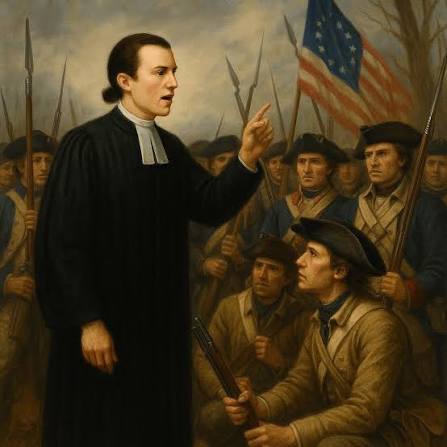
(a rendering of Gordon)
Roxbury’s Reverend William Gordon agrees with Bet. In the fifth of a series of essays printed a few days ago in a Massachusetts newspaper—around the time those silver-buckled shoes were last seen in the Stones’ home—Gordon holds up the examples of statements about natural rights, inalienable rights, self-evident rights, and Creator-endowed rights. Rooted in such ground, Gordon sketches a plan for the end of enslavement in Massachusetts. His essay appears as Boston and other communities debate the need for a new state constitution. Gordon’s views are a furtherance of anti-enslavement sentiment that’s existed in this region for about the past three years.
But the 48-year-old Gordon appears elsewhere at the same time that readers are absorbing his anti-enslavement essay. He’s at Fort Ticonderoga on southern Lake Champlain in northern New York. He’s been spending time with Continental General Horatio Gates, a highly popular figure across New England. Gordon enjoys the company of influential people and Gates seems to know everyone and all the ins and outs of various personalities, relationships, rumors, and decisions. Gates is also skilled at these kinds of encounters of food, friendship, information, and gossip. Amid their chatter is an exchange on the Continental Congress’s unhappiness with Gates’s nemesis and New England’s scapegoat for northern military failures, General Philip Schuyler of New York. Thank God, Gates and Gordon agree, Schuyler is on the way out and a rock-solid New England commander can go in his stead.
Gordon smiles at the thought of Schuyler’s departure and Gates’s elevation to the command—the same man who wants the Roxbury preacher to be the official chaplain for the northern army. From sight to meaning, all of this is fodder for a book on the war that Gordon has floating in his head.
* * * * * * *

(inside is the home office)
Philip Schuyler, like Thomas Stone, has a home in disarray. But that’s its normal condition. Called The Pastures, the Schuyler estate in Albany, New York, is about a hundred miles south of Gates’s quarters at Ticonderoga. It’s where General Philip Schuyler has turned his home office into a Continental Army command post. He lives there with his large family of seven children, six aged twenty to three along with a three-week old baby. Wife Kitty is still getting back on her feet.
Father and mother alike are strongly interested that their three oldest children—daughters all—get solid educations that range from dance to history to foreign languages to mathematics. Father and the rest of the family seem divided over a newly-acquired enslaved man named Prince; Schuyler actively dislikes him but the family and Prince are developing a bond between them. Besides time with his family and staff, Schuyler deals with a constant stream of military visitors and endless correspondence to those not coming to his home. Finally, Schuyler is still feeling the lingering effects of severe illness.
He’s also showing a kind of grim satisfaction. He’s resigned from his command of the northern army with the complete inner knowledge that he’d done his absolute best. With that comes a type of comfort, of relief, of giving it everything he had. But he couldn’t stop bad luck, or awful weather, or meager supplies, or ill-trained soldiers, or most of all, an incessant carping, complaining, and criticizing from various New England leaders who had insisted that a key war aim was the friendly invasion and conquest—say that again please, friendly?—of Canada. No, it was all too much and yet he barely knew the half of it—many members of the Continental Congress were at each others’ throats over who was at fault for the current situation. Thank God in Heaven, thinks Philip Schuyler on this eighth day of October, the resignation I submitted was exactly the right thing to do. From sight to meaning.
Barely hours ago in Philadelphia, where Bet and her silver-buckled shoes are on the loose, in a knock-down-drag-out roll call, the Continental Congress votes to reject Philip Schuyler’s resignation. The sight of a majority of hands raised “yes” will yield a meaning far beyond the Pennsylvania State House.
* * * * * * *
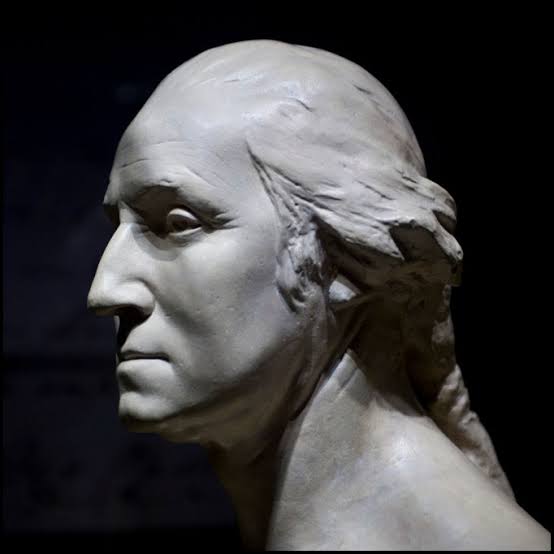
(older by the hour)
Geographically between the vote in Philadelphia that rejects Schuyler’s resignation and the quarters at Fort Ticonderoga that rejoices at his expected departure is George Washington. He is Schuyler’s commander, Gates’s commander, and overall Continental military commander subordinated by design to the Continental Congress. It’s taken all of a handful of minutes for him to see a sight and hammer out its meaning.
He sees the recent ashes and charred remains of the great fire of New York City, the conflagration that destroyed one of every four buildings in the city. Displaying a gallows-like candor unusual for him, Washington ascribes the deed to “Providence (God)—or some good honest Fellow has done more for us than we were disposed to do for ourselves” by burning up a city the enemy could use as a base of operations. They’ll still likely do that anyway, he adds bitterly. The words glow as hot as the fire they recount and revere—we lacked the will on our own to execute the community’s total ruination. We lack.
He sees reports that Loyalists in New York City are joining enemy units in the fight against the American Union and nation. They are “parricides” as he phrases them in a letter to Continental Congress’s presiding officer, John Hancock, who also bears the title of “President” (called Preside/nt in Redux). Washington wishes he could act against these Loyalists but confesses he has no resources to do so.
He sees Hancock’s description of the Continental Congress’s recent vote to organize and reform 88 battalions of a new army. His response is in tones and wording he hasn’t ever used before with Hancock; Washington states, “Your affairs are in a more unpromising way than you seem to apprehend.” Washington remarks sharply that the voting of 88 battalions and the actual use of 88 battalions in battle are two wildly different things. The inference is this: why stop at 88, you might as well vote for 1088 for all the reality that’s behind it. “I am thoroughly convinced,” as he draws the daggered letter to a close, “unless the most vigorous and decisive exertions are immediately adopted to remedy these Evils, that the certain and absolute loss of our Liberties will be the inevitable consequence…”
For Washington, things he can neither reverse nor prevent scorch the space between sight and meaning. The only unknowns ahead are the details of the next bad news he’ll likely have to convey.
* * * * * * *
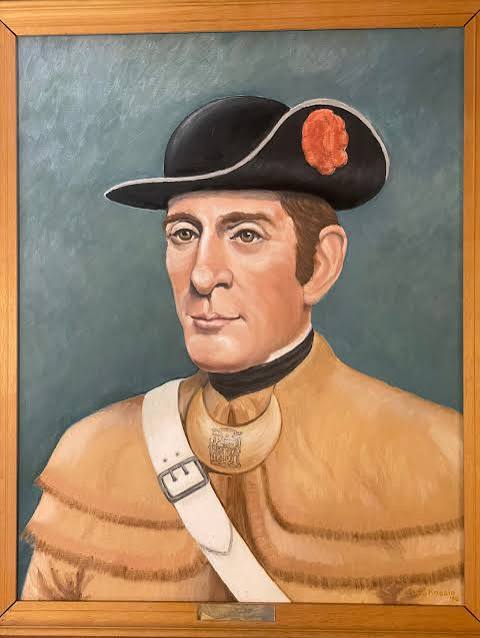
(rendering of William Christian)
It’s all north, all the time. The conditions and duties of the Continental Army are north. The attention and perspective of the Continental Congress are north. The latest and, to a significant extent, the first, re-emergence of anti-enslavement impulses are north. And on balance, the thrusts and accelerations of the latest work on state constitutions are north.
But what if these sights of the north aren’t fully the meaning that actually exists beyond them? There’s more to know in reaching the meaning in outer dimensions. That’s precisely what is true as this week unfolds to today, 250 years ago.
With sun-up of October 8, almost 2,000 men are in the midst of breaking camp at Double Springs, near the Great Holston River in modern Tennessee. Camp fires are doused, bundles tied up and placed in carts or carried in packs, and orderly marching begins. 34-year old William Christian is at their head as colonel.
He’s the brother-in-law of Virginia Governor Patrick Henry. Recently married but the target of his wife’s growing hatred for his absences, Christian is responsible for executing this third and final leg of the massive Native war planned and waged by a three-state, 7,000-man alliance of Virginia, North Carolina, and South Carolina. For the past three months, this vast conflict has taken place across an area roughly the size—and terrain—of Scotland. If any political leader can be identified as fundamentally involved in this startling endeavor, it’s Patrick Henry, who resigned a Continental Army command to become Virginia’s governor.
Christian and his men are going into the “Over-Hill” country of the Cherokee tribes. Sprinkled among the tribes are a handful of British officers and emissaries, urging Native attacks on Americans. The goal of Christian’s force is to do to the Over-Hill Cherokee what the latest three-state efforts have done to Natives south of here, destroying everything and everyone that can be killed, burned, seized, or captured. The destruction thus far wrought runs to almost incalculable measurements for the Natives.
Elected to be a member of Virginia’s new Senate, William Christian acts as Virginia’s westernmost figure of revolution, war, governance, and expansion. He supervises a monstrous amount of supplies transported alongside his force—thirty days of flour and seventy days of beef. He can adapt to either leading a battle or leading negotiations. He shows great care in maintaining scouts up to eighty miles out to forestall surprise attacks, while also stopping to check on small wooden outposts crammed with collections of sick people, adding up to 3,000 displaced settlers. He knows that the nature of this expedition is he’ll hear almost nothing from other states’ officers or from his state’s political leaders. But realistically, he’s self-contained, bringing together both the military and political sides of Virginia. He embodies on this day, seen standing near this river, a Virginia of American Union striking west as a new state of the American nation.
* * * * * * *
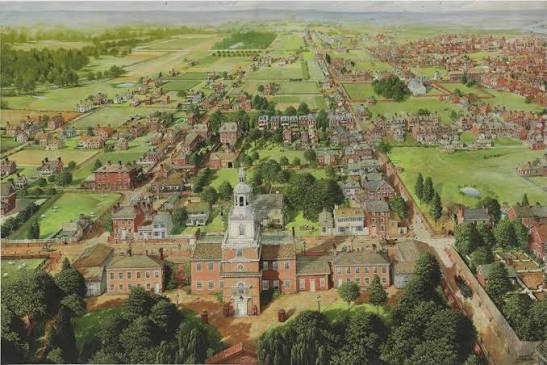
(where the two Philadelphians are)
Two people in Philadelphia fix their eyes on a sight.
One is Pierre Eugene du Simitiere, the 39-year-old Swiss immigrant who a few weeks ago served as consultant on the Continental Congress committee charged with creating a national seal. It was Simitiere who carried the assignment all the way to an actual sketch, not just a description. It was also Simitiere who introduced the use of a suspended all-seeing “eye of Providence” and the “e pluribus unum” Latin term for “from many, one”. Like Reverend William Gordon who’s meeting with Gates in northern New York, Simitiere makes a habit of collecting every shred of information he can about the war and the cause. Unlike Gordon, Simitiere asserts that a seal can express as much as a book. Maybe more.
Today, he’s gotten a request from representatives of New Jersey’s new government. They want him to create a design for their state’s seal. Part of the design, they inform him, must include three plows to emphasize New Jersey’s farming economy and heritage.
The other Philadelphian with fixed eyes on a sight is Martin Evans. He’s a young teacher who has opened a new school. He wants to see more students enrolled in his learning venture. To get them through the door and into the seats, Evans believes someone else needs to see a sight—the student’s potential for a bright future. That vision can be for a young boy or girl for his day school or, Evans plans, for an adult who decides to enrich their education in his night school. Whichever the case, Evans offers to teach students algebra, writing, reading, Italian-based business accounting, geometry, surveying, navigation, and skills in measuring distances in space and heaviness in weights. Martin also pledges to keep moral education in mind.
In a school you see preparation, in a seal you see independence, and in the combination you see a chance to pursue their meaning.
* * * * * * *
A fraction of a second elapses between the time seen and the first meaning envisioned from the sight. As the interval grows and first instinct strides toward further insight, the meanings evolve.
Also
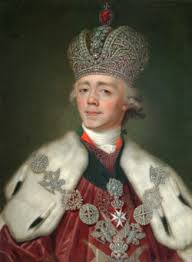
(the Russian newlywed)
The honeymoon has started but it’s not clear how long the honeymoon will last.
The marriage between Russia’s Grand Duke Paul and Sophie Dorothea of Wurttemberg is twenty-four hours old. It’s the hope of the Duke’s mother, the Russian Empress Catherine the Great, that the match and matrimony will strengthen the grounding of Russian influence across western and northern Europe. The “cold war” between France and Great Britain has destabilized the continent and the Russian monarch sees in this marital arrangement a solid chance for the growth of Russian power.
* * * * * * *
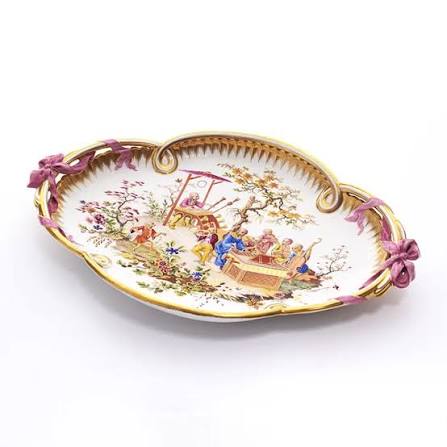
(a hot item)
Seeing the same turbulence spotted by Russian leaders in St. Petersburg, French King Louis XVI wants to extend French trade relations eastward rather than relying solely on Atlantic commercial connections. He has pushed French officials and craftsmen to ramp up production to satisfy the order of the Chinese Qianlong Emperor for the finest porcelain patterns. The French king knows that keeping the Chinese ruler happy can translate into greater orders for French porcelain. More Chinese trade for the French can allow the government to adapt to lower western Atlantic trade disrupted by the British.
* * * * * * *
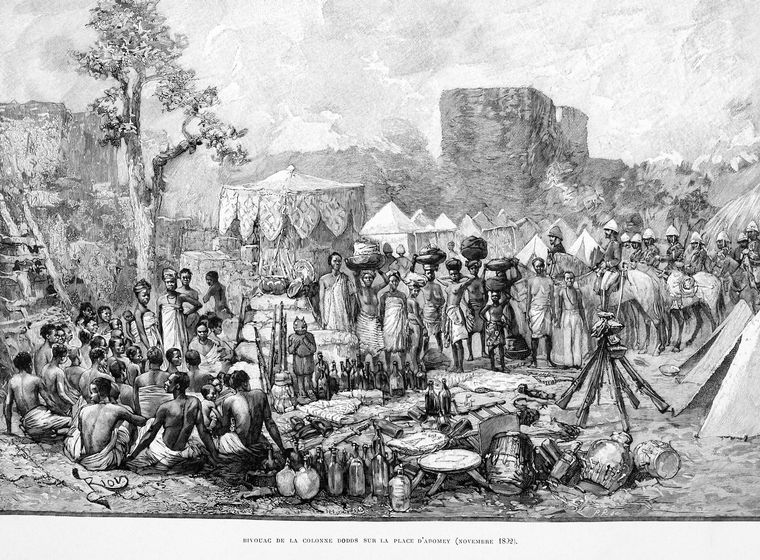
(part of Dahomey)
King Kpengla, ruler of the Dahomey regime in western Africa, sees the data right in front of him. The number of enslaved people hauled to him by private traders from within the continent is dropping. That means the 6.5% tax he’s charging for every sale of an enslaved person to the Atlantic-based slave traders brings in less revenue than the year before. Kpengla has to act to stop the drop—he needs to figure out what to do with his rivals, the Oyo Empire, which has seen gains in its slave-based revenue. A deal? A reform? A war? Something else? The sight is clear but the meaning of a solution is not.
For You Now

Go back to my admittedly fuzzy iPhone image. You know what you see, likely, the Moon and various points of light. Using the Moon as your center, follow up and then slightly rightward: you’ll see Regulus, Jupiter, and Mars. What you won’t—repeat, won’t—see are the dimensions and depths of the relationships between them.
To get at that, you have to know a certain amount of astronomical facts, use imagination, or ideally, both. That helps you add to what you’re seeing. That helps with the meaning or at least gets you going toward further meanings.
Track back for a moment to find a worthwhile method for understanding what you see in the photo and what the photo means. I find three steps in doing so. First, you have to take the time. Without time spent, chances for growth slam shut. Second, you have to focus your thoughts and, equally important, your thinking (I like splitting them into a pair). Third, with this focus setting the stage, you have to apply yourself. Actually, I prefer to say it differently: you have to press your mind. Pulled together, you can utilize this simple three-step method as a start for moving from sight to meaning.
Sight-to-meaning marks our Redux for today. Bet sees the household and decides it’s time. Having written a powerful essay, Reverend Gordon sees a chance to gather material for a future book. Washington sees ashes and laments the reliance on a person who did what needed doing; he also sees paper actions and warns of bloody results. Moreover, we’re seeing a southern (and early expression of a states’- rights culture) part of 1776 that’s been heretofore blotted out by events to the north. And those two Philadelphians have their own sight-to-meaning moments. By today, the war is night filled with flashing points, each arriving as light from a source of fire.
To see the dots of light is not to know the dots of light. You’ll need to move to get from the seeing to the meaning.
Suggestion
Take a moment to consider: which is more challenging—making time for your mind, focusing your mind, or pressing your mind?
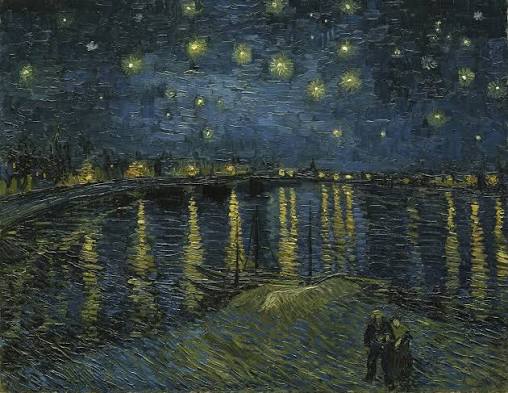
(Your River, as imagined by Van Gogh)