Americanism Redux
October 29, Your Today, on the journey to the American Founding, 250 years ago, in 1776
See that? Hear that? Smell that?
Whatever “that” happens to be for you, it’s something that didn’t mean much before. But now? Well, it’s everywhere in your life, a sure sign of the change that’s taken over much of your present moment and foreseeable future.
Yeah, there it is again.
Back at it.
Welcome to today, 250 years ago, and to Americanism Redux.

* * * * * * *
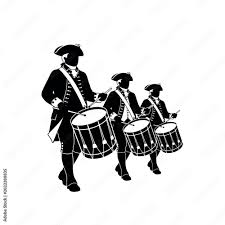
Rat-a-tat-tat-tat. Rat-a-tat-tat-tat. Rat-a-tat-tat-tat.
Over and over, in a long, unbroken sequence, the drummer beats the drum lightly with his sticks. It’s a signal.
The sound reaches the ears of Robert Hanson Harrison, seated near the command tent of General George Washington. Instantly, Harrison scratches the quill pen across the paper:
“Our drums have beat to Arms and Men ordered to their several posts, most probably some important event is upon the Eve of taking place.”
An attorney by education and mindset, Harrison knew well the sound of books plopped on tables, judges tapping their gavels, and papers rustled on desks.
Now, he’s all about the rat-a-tat-tat-tatting of snare drums and the flapping of satchels, powder horns, and knapsacks as uniformed men begin to run.
Yesterday, the 28th, two armies clashed in battle at a place called White Plains, north of New York City.
* * * * * * *
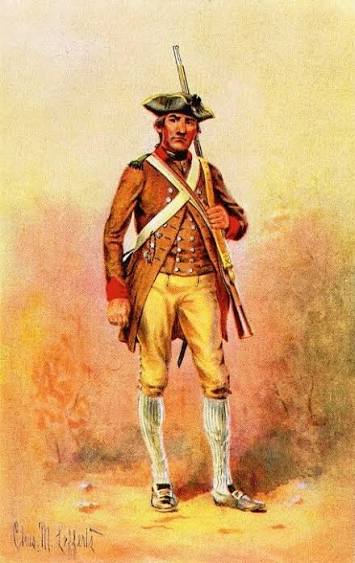
It’s a lot for a 58-year-old man. Elisha Beckwith lugs a pack, his smoothbore musket, powder, shot, blanket, water, a little food, a thick coat, and God-knows-what-else, to say nothing of the feelings and thoughts in his mind, which may be the heaviest of all. He’s in a short-time unit, signed up for temporary duty in an emergency.
Woods, creeks, ravines, stone walls, thick pastures, brush: every step adds a pound.
Across the way, the enemy. Minutes pass. Commands shouted. Into position. Drums playing. Firing begins. Explosions. Smoke rises, the smell too, laced with sound. Then, one other sound, one other sight. Metal strikes a 58-year-old body, and a red stain forms on the coat. Elisha falls to his knees, slumps to one side, and dies in the grass at White Plains.
A few miles away, Beckwith’s three sons wait in other Continental units from Connecticut. Back at the family home in Lyme, Adelaide Beckwith is busy with another day of work and, of course, another day of worry about her husband and their children. Perhaps, when the awful news appears at the cabin door, Adelaide will see or hear or smell something that will remain the rest of her life.
* * * * * * *
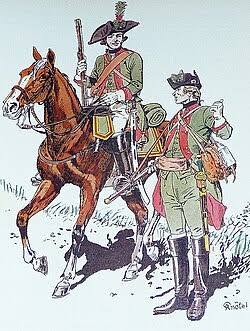
(Jager)
32-year-old Johann Ewald is from Kassel, in modern-day Germany. He’s a hired soldier of British King George III’s, one of several thousand now in America, and more than that, he’s a jager, a specialist in irregular warfare from his skill as gamekeeper and huntsman. Indeed, for the past few days, when he’s not eating roasted meat that an hour before was a live chicken, or duck, or hog, he’s been thinking through his personal theory of “partisan warfare.”
Yesterday, however, he put theorizing aside as he moved swiftly, skillfully, and stealthily with his jager unit in front of his allies, the marching Redcoats. Besides his uniform and various containers strapped or slung over him, Ewald had a jager rifle with spiraled grooves inside the short barrel. In his belt was a hirschfanger, a small hunting sword. Up ahead, enemy soldiers were seen. Ewald saw other allied officers call for cannon to be brought forward and wheeled into position. Orange fire bellowed and metal screamed through the air. The enemy’s soldiers fell back toward higher ground to regroup, leaving a few dark shapes lying in the grass as the drums beat. Ewald and his jagers slipped by the lifeless figures.
The British drove their enemy off the battleground of White Plains, a textbook’s victory. A British officer has his own theories: “From present appearances the destruction of Washington’s Army seems extremely probable; and if that Army is destroyed or dispersed, the subjugation of the American Colonies, may be said to be nearly effected; for it is highly improbable they will be able to assemble another army in the field able to face that of Britain.”
After White Plains, the Americans withdrew to rougher terrain a few miles distant, bloodied and unbowed and with all the problems of a yesterday dawned as today, the 29th.
* * * * * * *

(the tavern)
Yesterday? It’s a dream to Timothy Dodd, fading fast into an unreality of better times. Today is a nightmare, a forever state of darkness. He has no idea of an edge, much less an end. There’s not a place he can see that is beyond the reach of the terror inside him.
It’s because he tires on his ride into Bristol, Pennsylvania, slightly northeast of Philadelphia. He stops at Charles Bessonet’s tavern, which doubles as a post office. Dodd finds a place to sit. A few minutes pass, he’s unwinding, relaxing, even allowing moments to sit back and take things in. Sounds of people talking in low voices, a few chairs scraping softly on the floor, the clatter of cups and plates and utensils. Hospitality and refreshment, tonics to the weary. Legs stretched out, both hands resting on the table, there might be time for just one more.
Then, he feels it, inside his gut. Growing by the second, an inner fear spreads from mind to heart to soul in Timothy Dodd. He looks under the table—nothing; over in a corner—nothing; in the next room—nothing. The bundle he brought in with him, where is it? For God’s sake, where is the bundle of tied-up papers? Okay, take stock, and breathe; walked in, sat down, loosened up, set it down. And then…blank. What was next? No answer, a darkness, and it’s nowhere, the bundle has vanished! Only nothing is left.
Timothy Dodd is an “express carrier” who works out of Boston. He’s been carrying messages and information packed together—bundled—for the past several months for leaders and organizations in the Union cause. The Boston/Philadelphia and Philadelphia/Boston route is his normal beat. He’s earned a reputation as dependable, reliable, and trustworthy. He’s also, on an occasion or two, injected his own remarks and comments whenever he’s handed messages off to customers who happen to be media owners (printers), who then insert his observations into their written articles as “latest advice” or “fresh reports”. It’s Dodd’s way of building credibility, distinctiveness, and identity, what a later world might call “his brand” as an express carrier.
What’s the big deal about this missing bundle at Bessonet’s tavern? Why the panic in Dodd as he frantically searches the space?
Dodd’s bundle includes state government documents from Boston intended for the Continental Congress President John Hancock, the only delegate known by the public to have signed the three-month-old Declaration. Much, much more than that, however, is the inclusion of letters picked up from Continental Army General George Washington’s headquarters near White Plains. Washington’s letters include sensitive details about current army positions and conditions as well as correspondence to South Carolina delegate Edward Rutledge, to other military staff, and to Washington’s own family, every line of which might be valuable to the enemy.
His reputation melting around him as logs burn in the tavern hearth, Dodd leaves Bessonet’s place and rides to Philadelphia. Downcast, he reports to Charles Thomson and John Hancock that the bundle is lost or gone or stolen in Bristol.
That bundle has become an empty space, and the empty space transforms instantly into a black hole. The void sucks in everything around it. Richard Peters of the Pennsylvania Committee of Safety has proclaimed that enemy infiltrators are spread across northeastern Pennsylvania; any hour could bring alarms of enemy-led uprisings. Prisoners-of-war are being moved away from roads and key public gathering places, while enemy sympathizers could be exploiting internal clashes over the proposed state constitution. Reports of potential enemy activity begin flowing in. Confusion has mounted over the succession of Benjamin Franklin (now two days into a secret overseas trip to launch a formal American diplomatic corps) as postmaster, creating a widespread safety gap in transmission of written data and communication. The town of Bristol, site of the tavern, has an active Loyalist population, which may extend into the family of postmaster Bessonet. These factors spin ever faster around the Continental Congress, the state’s constitution process, greater Philadelphia, and northeastern Pennsylvania, in very nearly the geographic center of the American Union and United States.
In a matter of hours, cries for immediate action break out, and hounds sprint toward Timothy Dodd and the trail of the bundle. The Cause could hinge on a chase that began in a tavern, among people enjoying themselves, a former haven in normal days.
* * * * * * *
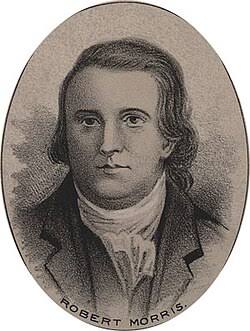
(Robert Morris)
Regardless of when the communication system is back up and running securely, a two-day-old letter by Philadelphia resident Robert Morris is one of the most remarkable of the year thus far. His correspondent is Continental General Horatio Gates, located at Ticonderoga on southern Lake Champlain.
Morris, a Pennsylvania delegate, had refused to sign the Declaration but agreed to do so in the secret signing a month after its adoption. His decision of opposition reflected his opinion of timing—he thought independence could be achieved later in the year, perhaps in a series of commercial treaties with Britain. To him, war meant chaos and an invitation to a host of dangerous unknowns and uncontrollables. As it was, he explains in this letter, independence first had led to constitutions second, all in a war setting, and all in a wild fury of debates, disagreements, and what he called “Intensine division”. Everyone but the army was enmeshed in the disputes. “I fear it will have baneful influence on the general measures of America,” writes Morris. To him, the wrong sequence jeopardized victory on parchment as well as battlefields.
Still, Morris explores his sense of duty, obligation, and responsibility. “I think it the duty of a good Citizen to follow when he cannot lead, and happy wou’d it be for America if all her Inhabitants wou’d adopt this Maxim,” states Morris. “Alas this cannot be, it is not to be expected from Human Nature. We must take men as we find them, and do the best we can.”
Morris the businessman closes his letter with two wartime forecasts: chances are good the Continental Army can survive into next year, and the French will then likely enter the war, with perhaps all of Europe pulled into a general conflict.
By then, will Americans be numb to war? And will the numbness break down all restraint?
* * * * * * *
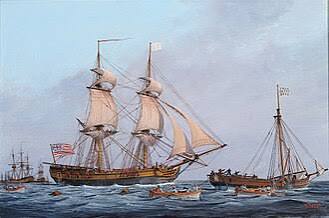
(Franklin’s ship)
Today, the 29th, 70-year-old Dr. Benjamin Franklin sees the last ribbon of land—the Delaware Capes—disappear just below the western horizon. He’s a day past Dodd’s missing bundle and the Battle of White Plains and two beyond Morris’s striking letter.
He’s aboard the Continental warship Reprisal, a brig with a hundred-foot-long hull, thirty feet at its widest, two masts, several cannon, and a 120-man crew, plus a dozen others, including the good doctor who describes himself now as a piece of old cloth resold at discount prices. This old garment with the long gray hair and wire eyeglasses heads east to Nantes, France, if the ship escapes capture. It’s his seventh trans-Atlantic trip.
Franklin’s self-description comes from his new assignment—to take charge of the Union’s diplomatic corps and on-the-ground formal foreign outreach. The task is massive in scale and importance; he’s received some 4,500 words of instruction and guidance, which includes references to upwards of fifty people (and likely their networks), spread across Europe, he will need to meet, know, and steer toward the American Cause. Topics and issues will span war, commerce, law, logistics, and culture, with each having subsets of their own. He’ll also have to manage existing American representatives, some of whom have ambitions and egos on the scale of his assignment. Overall, Franklin’s goal is to create treaty alliances (starting with France), neutrality agreements, or at a minimum, an unwillingness to act in support of America’s enemies.
Once landed, Franklin will consistently lag two months behind all events in America. If ever or whenever he learns of Dodd’s missing bundle, of the Battle of White Plains, or of Robert Morris’s insightful analysis, God only knows what their actual status will then be in real-time. He’ll just have to act on his own best judgment.
A westward glance back from the deck of the Reprisal shows only water and a moving horizon. The ship hauls a heavy load.
* * * * * * *

(current French Church)
Ann MacKenzie is on Queen Street in Charleston, South Carolina. She can see French Church just across the street. A husband and wife sit across the desk from her. Ann asks them for a few more details: describe your ideal situation. They reply, “The management of a farm, as (we) have both been in the farming business for some time.” Anything else? The husband answers, “(I) would be glad of the Tuition of a few Children, (I) am capable of teaching Reading, Writing, and Arithmetic in all its branches.” Ann continues writing for another minute, and then thanks them for their time. They leave Ann, heading onto Queen Street.
Ann will visit the printer of the South Carolina and American Gazette and pay for her advertisement’s insertion into the next edition of the newspaper. With any luck as a kind of broker, she’ll be contacted soon by someone interested in the couple. This unnamed husband and wife hope the things they know best—from the smell of livestock to the sound of students—will guide them forward in their married life.
* * * * * * *
The familiar has a way of fooling you. It can change faster than we think. A leaf is a leaf, but green isn’t gold and summer isn’t fall. The familiar we find in one form can re-form in another.
Also

(Salsette Island)
Is that who we think it is, who he claims to be?
It’s the 29th, and in the vicinity of Salsette Island, near modern India, is a man who says his name is Sadashivrao Bhau. He’s heading toward Bombay, where he’ll seek protection by British military forces. The only problem is Bhau was believed to have died in battle fifteen years ago. William Hornby, governor of Bombay for the British East India Company, is in the midst of a strange effort to identify the man.
Hornby doesn’t want to offend the followers of the man. They’ve been attacking armed forces controlled by the Maratha Empire, seeking to overthrow the British-allied regime. Hornby and other imperial officials are struggling to separate various Maratha factions from one another. A treaty with the Maratha has recently been signed.
For the British, the inability to know who this man really is seems to reflect a broader inability to know which way to turn. They can’t tell what they don’t know.
For You Now

(the familiar as a landmark)
The familiar helps us make sense of our surroundings. It’s a sort of comfort-sign, a reassurance that you are where you are. Many of us prefer to use the familiar for guidance in establishing direction. Yeah, we might say when we see the familiar, now I know where I am. It’s the landmark.
When change strikes, we choose to reset the familiar. A new form emerges, and through repetition, it qualifies as the new familiar. The sound produced by the beating drums causes attorney-turned-military staffer Robert Hanson Harrison to conclude a battle is likely to begin.
When change strikes, we may discover that the familiar is both new and old at the same time. That can be especially unnerving. Timothy Dodd has been in and out of taverns before, and he’s likely forgotten something before, too. But this is different. The world has changed and this particular lost bundle at this particular moment may mean the ruin of him, to say nothing of the broader American Cause.
When change strikes, the familiar can enable you to discover a new perspective, a wider view. Robert Morris is one of the most successful businessmen in the American Union. He has long experience in deals, negotiations, and managing risk over amazing distances. He uses this foundation for seeing further and deeper than most people of his time. Perhaps most of all, he reaches an elevation of perspective on his duty and its dimensions.
When change strikes, the familiar can take you into a range of work you never imagined. Benjamin Franklin has a past marked by broad networks, from science to service, from lightning bolts to mail routes. Now turning into the latter stages of life, he’s encountering a different sort of challenge in this week, with stakes of such height that only an inner courage can sail him forward, the seventh time across.
Your mind is a place where the familiar stays but should never stick.
Suggestion
Take a moment to consider: is there a new familiar in the United States?

Screenshot
(Wabash River’s headwaters, familiar looking)