Americanism Redux
November 5, your today, on the journey to the American Founding, 250 years ago, in 1776

Is this really where we thought we’d be?
Months ago we started, we began, and I feel like by now we’d be…I don’t know…maybe a lot farther along? I don’t think I would have been happy if, back then, you’d told me this is where we’d be.
Am I missing something?
Today, 250 years ago, and the path ahead seems clogged and thick.
* * * * * * *

Solomon Nash is sick. His buddy is sicker. Together, over two days, they traipsed fifteen miles to a hospital.
The two men belong to a Massachusetts Continental artillery unit. The hospital, located in North Castle, New York, is in a church. After a couple of days, the sick and wounded are separated; Solomon and Luke and the rest of the sick go to a small house while the wounded stay in the sanctuary.
At the house, Solomon spends time with Luke, records the weather day-by-day, and talks with other soldiers and learns his unit and the Continental Army have pulled back a distance from the British after last week’s battle at White Plains. He also sees an infected arm, a bloody saw, and a man crying in pain. The man seems for the moment to have survived the trauma of amputation. It’s not clear where the man will go—to the house or the church or, God forbid, the graveyard nearby. As for Solomon, each day he’s feeling a little better.
It’s been a crazy year. Solomon started his military duty at Roxbury, Massachusetts, back in January, around the time that Thomas Paine published “Common Sense.” He participated in the final weeks of the siege of Boston that drove the British out of the town. Artillerymen like Solomon were key factors in the bombardment that led to victory. He and his unit then sailed in boats to New York City when General George Washington moved the main Continental force there to ward off a British invasion. He heard the Declaration read aloud and saw a statue of George III torn down and ripped apart. Since then, the lack of Continental success against the British in southern New York was encapsulated by an embarrassing incident involving Solomon Nash and his unit: they mistook Washington’s barge on the Hudson River for an enemy vessel, fired on it, and killed or wounded several people aboard. Either they missed Washington or he was on land; regardless, the commander survived the friendly fire of Solomon Nash and his comrades.
Nash has two nightmarish memories now—almost killing the Continental Army’s commander and the man who had his arm cut off.
He’ll pick up his pen, draw a line as a border between one day’s entry and the next, and write:
“Today nothing remarkable.”
* * * * * * *

(running away…or running to?)
General George Washington hasn’t met Solomon Nash, but men like him are very much on his mind. And that worries him, to the point of now identifying a second enemy threat.
No, it’s not the British, though they’re #1 at the top of the list. The second enemy—#2—is the “dissolution” of his organized armed force, the men’s collective decisions to desert, refuse to re-enlist, or to behave in such ways as to require their removal.
Too many men are being sent to or allowed to remain in hospitals. Washington wants to find who can still serve on guard duty or do some meaningful activity as they get back to a fit condition. Too many men are being allowed to just leave camp and walk home. Washington denounces officers commanding regiments and companies for their complicity. Too many men are burning barns and sheds owned by local residents. Washington orders it stopped, though nothing seems to deter the practice. Too many men are going hungry and living on paltry or spoiled rations. Washington urges the acquisition of more food. Too many men are firing weapons randomly in camp or don’t have functioning weapons at all. Washington demands punishment of rule-breakers, and also orders that every unit get into formation and fire off their muskets, emptying firelocks and gun barrels of bad powder.
“Our situation is altered in no instance,” Washington dictates to an aide, “unless in the number of our troops, which is every day decreasing…”
Two weeks ago, Washington had realized his Continental armed force was something new, a “moving state of the Army” that could prove pivotal in denying victory to the British. Now, the entity becoming a “moving state of the Army” could move into a state of decomposition.
* * * * * * *
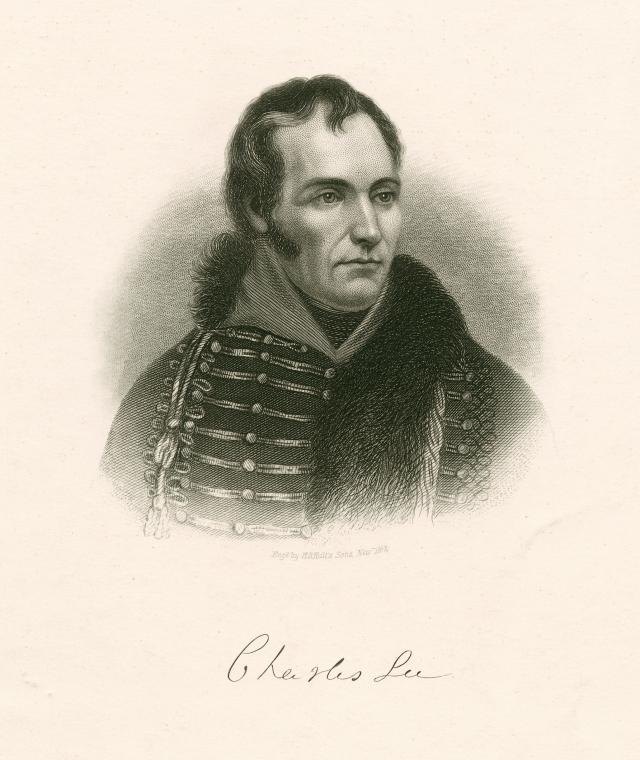
(Charles Lee)
Roughly ten miles from George Washington and five miles from Solomon Nash is Continental Army General Charles Lee. He’s one of Washington’s most prominent core-team members, currently leading a segment of Washington’s overall force. He’s colorful, eccentric, a military veteran, a military consultant, and quick to see opportunities and hear different ideas.
Lee believes the army is, overall, “in a very tolerable secure condition” after deflecting British attacks and landings north of New York City. He expects the Continental forces to “harass [the British] most damnably” over the next few weeks. The biggest threat, in Lee’s opinion, is internal, not external: Congress has no military expertise, no militarily oriented delegates to make and execute policy. To Lee, everything that appears as a problem in the Continental Army can be traced to an originating failing in the Continental Congress. He’s not saying it outright, but a principle lurks: in time of war let matters be done by men of war. Whether the idea germinates just yet or not, Lee envisions the weather and the season motivating a British shift southward, perhaps to the region around Philadelphia. He wants to command “a corps of observation” at Princeton, New Jersey, or Bristol, Pennsylvania.
Maybe then, with war as a neighbor in the mid-coastal winter, the Continental Congress will come to its senses and see what Lee sees. And he’ll also be nearby.
* * * * * * *
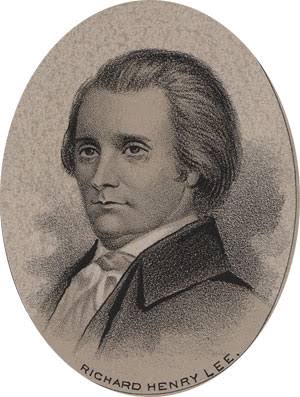
(Richard Henry Lee)
As life would have it, another Lee of no relation, Richard Henry Lee, is in Philadelphia at this very instant. Richard Henry Lee is a Virginia delegate to the Continental Congress and, frankly, he’s a bit frustrated. Because of the recent furor over lost secret communication at a Bristol tavern and turmoil in the Continental postal network (see last week’s Redux), Lee assumes the worst: his previous letter to his fellow Virginian Thomas Jefferson must have disappeared, whether stolen or lost. Lee’s rewriting the Jefferson letter now, and in so doing, Richard Henry Lee reveals a different side of independence.
Lee chastises Jefferson for resigning from Congress and rejecting a role in the new diplomatic corps in Europe. Such elevation of private desires over public service means “we are gone, beyond redemption lost in the deep perdition of slavery,” writes Lee, invoking a subject he knows well as an enslaver. He’s mildly optimistic, seeing hope, first, in the successful blocks made on British invasions throughout upper and lower New York, and, second, in the likelihood for war across Europe, which would complicate life for Britain. Less happily, though, Lee bemoans reports of criticism of himself in Virginia’s new government and asks the Williamsburg-bound Jefferson to stay vigilant on his behalf.
Then, in an extraordinary moment, Richard Henry Lee writes out what he regards as the biggest problem in the Union—the lack of crews to serve on American naval ships. No crews, no ships; no ships, no protection of ports; no safe ports, no trade coastal or overseas; follow the chain and the Union dies by strangulation. Okay, and his recommendation for addressing this problem, which he ranks above anything facing the Continental Army? Showing the depth of the danger to the Union, Lee answers: “binding out Orphan and Poor Children, and direct[ing] that, for some time at least, the whole of such Children should be bound to the Sea.” Richard Henry Lee advises the use of child-crews to work the Continental Navy’s vessels that protect ports as well as the trade coming in and out of those ports. So the Union will live on.
Richard Henry Lee’s idea for a child-crewed navy is miles from late spring, when he’d led the drive inside the Continental Congress to form three committees for writing a declaration, a governmental framework, and a template for foreign treaties. A full million miles.
* * * * * * *

(Charles Carroll)
39-year-old Charles Carroll, a devout and wealthy Catholic educated in Europe and fluent in French, looks at two structures in his hometown of Annapolis, Maryland. The sites are a musket’s shot apart.
One structure is existing, the Old Council Chamber. The other structure is new and unfinished, still under construction, intended as the new facility for a Maryland government.
For the last few weeks, Charles Carroll has spent his life in hours and hours of meetings in the old building. He’s one of the delegates arguing over a draft constitution, part of a group that claims the opposing group is hell-bent on destroying the existing structure of life overall in this place. But truthfully, he can’t say with any confidence—none, in fact—that the arguments really matter in a bigger sense. Carroll is increasingly resigned to think the entire Union cause and endeavor will collapse before the new building is finished, occupied, and put to work as a seat of American government. As a Bible reader, Carroll knows all about misbegotten temples.
Carroll roots his pessimism in his view of daily reality. That’s the scale he’s seeing with reports from Washington’s army and his own interpretation of them—the armed force shrinks by the day. War is killing the Union and the cause, one disappearing soldier, a dozen disappearing soldiers, a hundred disappearing soldiers at a time.
Fine, great, as early November creeps along, maybe the constitution will get done in the Old Council Chamber. Hooray. But that new government building over there, along the street with a gentle upward grade as you walk from the docks? Why rush it?—get it done at its own pace. It’s not like victory is around the corner. Perhaps a negotiated peace is the best to be hoped for, and a viable community will exist for whatever government ultimately sits in the new building. If the divide can be bridged in the Old Council Chamber, maybe the divide that feeds the war can be crossed as well.
* * * * * * *

(where Benson walks)
George Benson steps from the dock of Alexandria to the deck of Anne Maria. Smell that air. Wow. Is this what freedom feels like?
On the vessel, Benson feels an ever-so-slight rocking movement beneath his feet. He’s lugging one of the last crates to be loaded onto the schooner. Any day now, Captain Francis Speake will shout the command and the crew will pole and row the vessel into the main channel of the Potomac River. One of those men powering the boat will be George Benson.
Ah, freedom…
…or, comparatively, something very much like it.
Up to now, Benson has been free in the most basic sense—in his mind. Beyond that, he’s given up much of the rest of his freedom to live as a forced laborer; he’s an indentured servant to John Rand, a businessman in Alexandria whose enterprise combines servicing vessels—with baked goods, food, and labor. Benson’s forced labor falls into that third category for the next three years with Rand. Over the past two weeks, Benson has worked to outfit, load, and prepare to crew the schooner Anne Maria.
But those days appear to be done.
The Anne Maria is funded, crew and cargo alike, by a four-way business collaborative comprised of three partnerships and one person, all based in the Chesapeake Bay world of Virginia and Maryland. The collaborative’s sole individual is Matthew Tilghman, a co-delegate along with Charles Carroll slogging it out at the Old Council Chamber in Annapolis. The water in life’s river runs all mixed up.
And that water mixes even more.
The four-way collaborative cuts a deal with John Rand to take over the remainder of George Benson’s forced labor time. They agree to pay what’s owed Rand for Benson’s work AND take over the rest of the three-year obligation AND agree to give Benson a month’s wage in advance. This is the collaborative’s response to the fierce competition for skilled ship crews—the very problem Richard Henry Lee said will destroy the Union and is best addressed by the forced labor of child-crews. Those waters get weird.
So, meet George Benson, now walking in steps more employed than indentured, carrying a crate, with the most money in his pocket that he’s ever seen in one sum that he can call his own.
This is his new level of freedom.
* * * * * * *
You may not be able to see it, but in the distance, after every start, is the downward curve of the earth ahead.
Also

(before she was a mother ten times over)
Moms are moms. Proud of their children. Give them a reason and you’ll get an earful of how successful they are.
Dowager Lady Howe is 73 years-old and will talk to anyone who’ll listen about the conversation she had a few days ago with King George III, her first cousin twice removed.
She’s German by birth and by language and by learning. When she speaks you’ll hear the accent—it’s the flavoring of words in her excited recounting of all the wonderful things the British monarch, who shares her Hanoverian heritage, said about her two sons, William and Richard. She heard the king praise their amazing work as General and Admiral of British forces in America in crushing the rebels and their rebellion. “These are the only people I could have made choice of on this occasion,” repeats Lady Howe of one of the king’s German-made sentences.
She smiles. Things going well after relying on her two sons? What else did anyone expect of a Howe?
* * * * * * *

(two books of this year)
Elsewhere on the British Isles, two authors respond to the latest stages of reaction to their books published earlier in 1776.
Edward Gibbon discusses his first volume of the planned “Decline and Fall of the Roman Empire” with some of the most influential people in the British imperial government. He’s met with George Germain, a key official of George III in waging the war in America. Gibbon has heard very optimistic updates from Germain as well as his desire to “reconquer Germany and America.” Gibbon gets data on the number of American deserters; the enemy’s army is seeping away, day by day. He’s responding to critics’ religiously-based attacks on his book and also wondering about hiring a French translator to broaden the book’s market onto the European continent.
Adam Smith confronts a more concentrated form of criticism. Critics are disputing his understanding of current trade and business, not his historical interpretations. Among the strongest counters to Smith’s work is Thomas Pownall. He’s a former imperial administrator and colonial governor in America. Pownall took Smith’s work seriously and reacted forcefully, asserting that, while imaginative, it did not reflect imperial reality.
Both authors are seeing book effects, rippling throughout their side of the English Channel.
For You Now

Quite a journey from Solomon Nash to George Benson, don’t you think?
You’ll often think that where you are right now doesn’t look much like where you thought you’d be when you started out. Nash didn’t expect to see an arm cut off or to have mistakenly killed people on the army commander’s barge. Benson didn’t envision having the biggest wad of money he’s ever held to be in his pocket at this moment. Much the same sort of start-to-now unexpectedness can be found in other stories of the entry.
My thought is that you can’t keep going indefinitely without coming to some sort of reckoning as to why, how, and when. You’ll need to account for the shift in “where you began, to where I envision, to what I’m actually seeing.” If someone tries to say “forgetaboutit”, you’d better be instantly on guard. Check the doors and locks; they’re stealing something.
Let’s do a quick breakdown of why/how/when.
Why—the driving factor in the change since the start is…? Also, was the answer a conscious choice or did we back or fall into it? What’s the actual distance between us-then and us-now?
How—did we shift a lot of resources, miscalculate a particular action, or was the change shown in some other way? Have our goals shifted, too?
When—do we know exactly? Was that moment a shock? Did we try things in the aftermath of that moment?
The Why/How/When test can be applied to Washington’s Continental Army. Why has the army seen desertion become an existential crisis? How did we miss seeing it? When did it become the most overriding factor in front of us? These are crucial questions at a time when Washington has a “second” start with his newly emerging idea of “the moving state of the Army”.
You can find yourself in a surprising place when you look back at the starting point.
Suggestion
Take a moment to consider: choose a start date of something significant to you—how does it look from then to now?

(Your River)




Speak Your Mind
You must be logged in to post a comment.